THE TB-500 FIELD GUIDE
TB-500. A closer look.
The name is everywhere. The science takes a little more care. Start with the molecule, follow the evidence, and leave with better questions.
Plain-language guide · Checked 2026-10-22 · Source links below

The TB-500 fragmentAc-LKKTETQ · seven amino acids
Full-length thymosin beta-4The mature parent molecule
Related does not mean interchangeable. Match every finding to the exact molecule studied.
YOUR WAY INTO THE SCIENCE
Curiosity looks good on you.
Start with a question. Follow it somewhere useful.
Start with the molecule.
Seven building blocks, a longer parent chain, and the detail that changes the question.
Follow the evidence.
Open nine studies. See what was tested and what each result can tell us.
Ask better questions.
Identity, quality and safety each need a different kind of proof.
Know the ground rules.
Canadian product checks and the current WADA sport rules.
Small words. Clear ideas.
A friendly dictionary for the terms that keep turning up.
Find a clear answer.
The questions behind the headlines, explained in plain language.
What is TB-500?
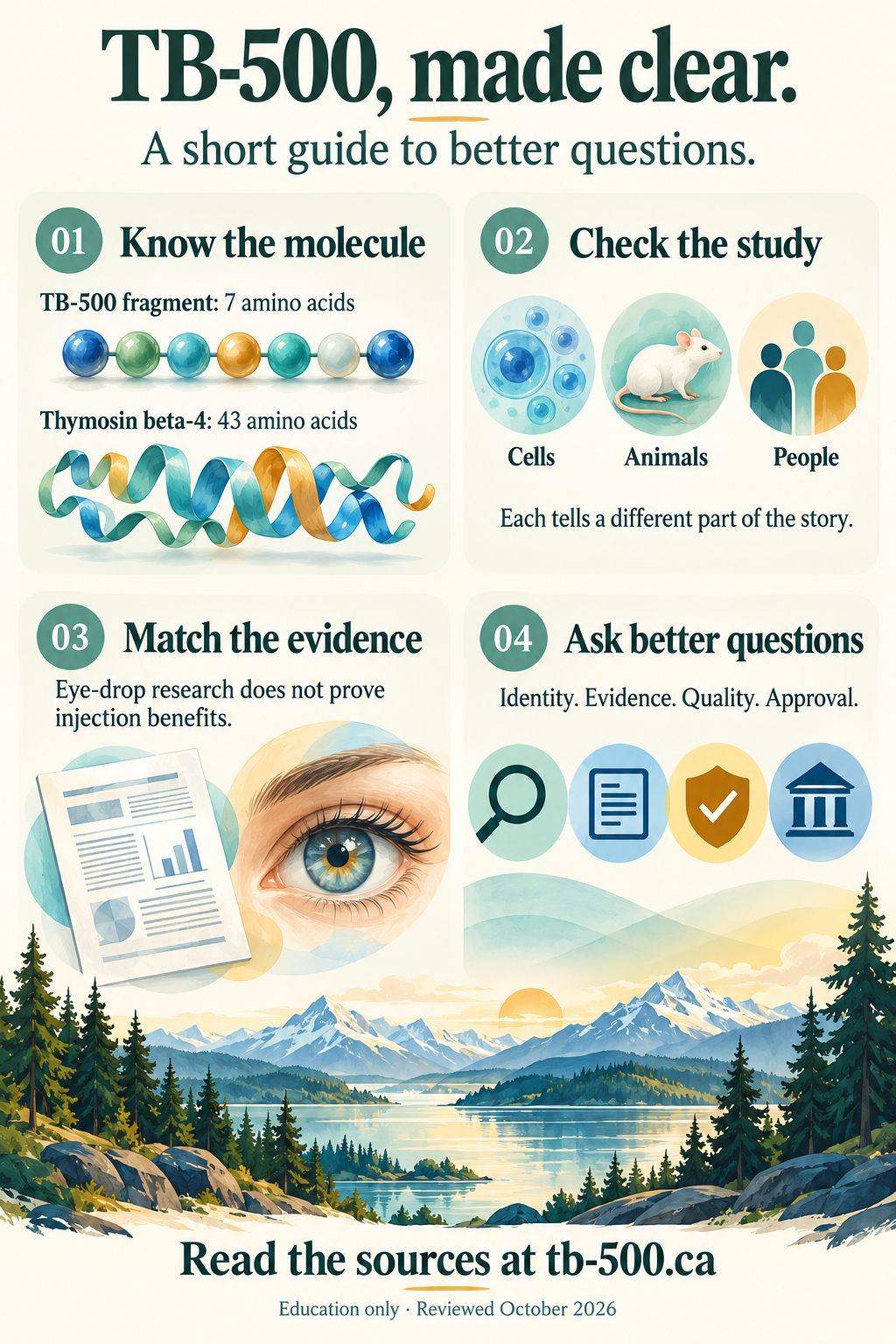
TB-500 is a name used for peptide products. A peptide is a small chain made from building blocks called amino acids. In an important identification study, a product sold as TB-500 contained a seven-block piece related to thymosin beta-4. The mature, full-length thymosin beta-4 molecule has 43 blocks.
A short piece and a full chain can act differently. The exact sequence matters more than the name on the front of a bottle. Some sellers use the same name for different materials. A product label alone cannot settle what is inside.
Sources: Esposito and colleagues, 2012 — chemical identification of a TB-500 sample · Philp and colleagues, 2003 — the actin-binding region and blood-vessel growth
Why are people interested?
Cells must move, change shape and work together as tissue grows. Thymosin beta-4 has attracted interest because of its links to that cell machinery. Researchers have studied related molecules in skin wounds, blood-vessel growth and eye-surface repair. These are real scientific questions, with different kinds of evidence behind them.
Online claims often jump from this work to faster injury recovery, easier training or better whole-body health. That jump needs its own proof. The practical question is simple: did a good study test this exact molecule, used in this exact way, for this exact result?
Sources: Van Troys and colleagues, 1996 — mapping the actin-binding site · Malinda and colleagues, 1999 — full-length thymosin beta-4 in rat skin wounds
Three things to remember
A promising idea is a reason to do a careful study. It is not a reason to promise a result. A study in cells can explain a possible process. A study in animals can explore a living system. Human trials must then test whether people actually benefit and what harms may occur.
This guide helps you read those steps. It does not sell TB-500, set out injection instructions, or choose treatment for you. If you have an injury or symptoms, start with a qualified health professional who can assess what is causing them.
- Name the molecule before comparing results.
- Separate a research finding from a proven human benefit.
- Check the original source, the date and the limits.
Keep exploring
New to peptides? GotPeptide’s illustrated guide explains the basics. Its TB-500 compound profile puts identity, research and seller listings in one place. We share ownership with GotPeptide and Get Brio through the Pat & Tony Cannabis portfolio. A portfolio link or paid banner is not a medical endorsement.
TAKE THE BIG PICTURE WITH YOU
Good science.
Worth sharing.
A colourful guide to the molecule, the evidence and the questions that matter. Save it, send it, or open the full text version.